The Imagery of Angels and Miracles
East of the MountainsThe imagery of angels and miracles gives religious language a recurring place in the novel’s encounters with suffering, but it does not offer a simple explanation for suffering or a dependable escape from it. The word angel is applied to Ben Givens after he offers medical help to a sick stranger, while miracle is used when his care helps a newborn survive. Between these moments, illness and loss resist easy consolation: the imagery gains force not as proof that pain has a supernatural solution, but as a way people recognize hope, generosity, and the fragile arrival of life.
Religious Language in the Face of Suffering
The motif is set against the limits of medicine from the beginning of the evidence gathered here. Dr. Williams tells Ben Givens and Aidan Givens that their mother’s pancreatic cancer cannot be cured. Ben objects that the doctor is a doctor, as if medical authority ought to make a cure possible; Dr. Williams answers that a doctor is not a magician. The distinction matters to the novel’s religious imagery: neither professional skill nor spiritual language can simply command suffering to end.
A related limit appears in the conversation about the mother’s pain and opium. Dr. Williams leaves the decision about how much medication to use to the family, framing it as a question of how much pain she can bear and when enough is enough. The exchange offers no miraculous resolution, only a painful judgment made within the boundaries of care. The religious vocabulary elsewhere in the novel therefore does not erase the uncertainty of responding to illness or dying.
Ben’s reading of the Book of Job extends that uncertainty into a direct engagement with religious consolation. Alone in a hotel room, he eats and tries television before turning to the Bible. He is disturbed by the story’s treatment of Job’s friends, who come to comfort him but are punished for misunderstanding God. Job’s restored health, enormous prosperity, and new family strike Ben as an almost excessive happy ending; the book’s final reminder that Job eventually dies keeps mortality in view. The episode makes the tension explicit: a story of restoration may comfort, but it does not abolish death, and attempts to explain another person’s suffering can themselves fail.
Care Given a Human Face
The strongest angel imagery appears not as a vision but as a name people give to an act of help. On a bus, Ben encounters a seriously ill young man, Angel, traveling with his brother. Catherine translates as Ben explains that the illness is serious and that medical attention will not cost the family anything. He also promises that they will not be asked for papers or even for the sick man’s name. These assurances answer practical fears as well as medical need: care is offered without making the family prove that they deserve it.
Catherine tells the brothers that the doctor will treat Angel for free and that nobody will ask about their documents or identity. The people around them respond by calling Ben an angel of God and a good man. The label comes from the passengers’ gratitude, not from a supernatural intervention. Its force lies in the contrast between their vulnerability and Ben’s willingness to take responsibility for a stranger. When Angel’s condition worsens, his brother says that God will help them; Ben does not replace that faith with a theological answer. He arranges concrete help, calling emergency services from the bus station and explaining that Angel needs immediate medical attention.
That sequence defines the motif’s moral emphasis. Religious hope belongs to Angel’s family, while Ben’s contribution takes the form of medical judgment and persistence. The emergency operator asks for information about both the patient and Ben, and an ambulance arrives within minutes. The narrative connects the passengers’ language of divine help with the ordinary procedures through which help becomes available. The imagery dignifies care without pretending that Ben can control the outcome.
The Miracle of a Birth
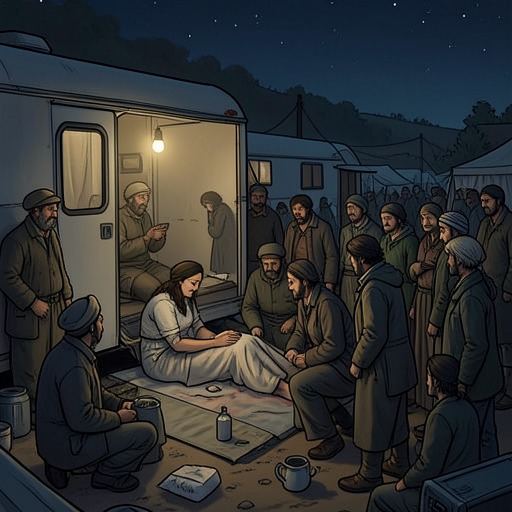
A second cluster of religious language accompanies Doris’s difficult labor. When Ben arrives at the trailer, a woman greets him with gratitude to God and says she has been praying for him. The scene places him in a role for which circumstances, rather than formal preparation for this particular emergency, have called him: the birth is already too far advanced for a hospital transfer. Ben assesses what is happening and prepares to help where Doris is.
After the baby is born, Ben checks that she can breathe and responds when she does not immediately cry. The infant gradually begins to move and cry, and Jimmy Perez crosses himself, calling the birth a miracle. Doris asks to see her daughter, and Ben places the cleaned, covered baby on her belly. The family’s description of the moment does not make the medical work disappear. Instead, the word miracle follows a sequence of close attention and action, and names the arrival of a child whose survival had seemed uncertain.
The response also completes a small exchange of trust. The woman who welcomed Ben with a prayer sees him remain present through the emergency; Jimmy’s reaction and Doris’s request to see her child turn the religious language toward relief and gratitude. The novel lets the family name the birth in their own terms without supplying evidence that its cause is supernatural. Its emphasis is on the conjunction of extraordinary significance for the family and the immediate human work that made a safe birth possible.
A Motif Without Easy Consolation
The contrast between these scenes and the account of Ben’s mother prevents angels and miracles from becoming a general promise that good outcomes will follow. A doctor cannot cure her cancer, and decisions about pain remain difficult. Job’s restoration does not persuade Ben that every account of suffering ends neatly; even Job dies. Against that background, the sick Angel’s family can pray, and Jimmy Perez can call his daughter’s birth a miracle, without the narrative claiming that faith has resolved the larger problem of pain and mortality.
The motif also echoes through Ben’s care for others beyond the encounters in which someone explicitly uses religious language. When Rex is badly wounded, Ben examines him, prepares the dog for treatment, and recognizes that his own medical kit and field experience will be needed to help him continue. Later, at a veterinary clinic, Ben chooses to stay while Rex undergoes further treatment, insisting that he wants to help. These acts are not called miracles, but they give the imagery an ethical counterpart: attention and responsibility persist where certainty about outcomes is unavailable.
Taken together, the episodes distinguish miraculous language from magical power. People use words such as angel and miracle to mark gratitude, hope, and the felt importance of life preserved. Ben’s actions do not establish that suffering has a divine justification; the novel’s encounter with Job, and the uncurable illness of Ben’s mother, keep that question open. The imagery instead gathers around acts of care that are modest in authority but consequential in human terms: offering treatment without conditions, calling for emergency assistance, staying beside an injured companion, and helping a child enter the world.